
Trends & Insights
How Much Does a Playable Ad Cost in 2026?
By Ali Raza · Oct 29, 2026
The short answer
A playable ad costs anywhere from a few hundred dollars to $30,000+ in 2026. Simple single-mechanic builds from freelancers sit at the bottom of that range; fully custom, multi-scene playables from specialist studios sit at the top (Atria, Playio).
The number on the quote matters less than what it includes. A cheap playable that gets rejected by AppLovin, or one that only works on one network, usually ends up costing you twice.
I build playables for mobile game studios and brands at TARC Solutions. Below is how the price actually breaks down, what drives it up, and how to avoid paying for the same playable twice.
Playable ad prices by who builds it
No network or agency publishes a standard rate card, so treat these as market ranges, not quotes.
- Freelance marketplaces: $200 – $3,000, 1–2 weeks. Single mechanic, template-based. You supply assets and do your own QA.
- Specialist playable developer or small studio: $300 – $5,000, 1–3 weeks. Custom mechanic, your art, packaged for the networks you name.
- Full-service creative studio: $5,000 – $30,000+, 3–5 weeks. Concept, custom art, multi-scene builds, multi-network QA.
- In-house team: no external fee, 2–3 weeks. Internal sprint time. Worth it only if you ship playables often.
Freelance, studio and in-house ranges are from Atria's 2026 breakdown; the full-service range matches Playio's 2026 analysis. The specialist row is where TARC sits.
What drives the price
Six things move a playable quote more than anything else:
- Number of mechanics and scenes. One tap-to-merge loop with an end card is cheap. A tutorial, two levels and a fail state is three times the work.
- Art. Reusing your game's existing sprites is fast. New illustrated or 3D art, or new animation, is usually the biggest single line item.
- File size pressure. Every network caps the file (more below). Fitting rich art and audio under 5 MB, or 2 MB for Meta's single-file format, takes real optimization time.
- Number of networks. Each network wants different packaging and a different install call. One build for one network is cheapest; one build adapted to five is not five times the price, but it is not free.
- Variants. UA teams rarely run one playable. Colour, difficulty, copy and end-card variants for A/B tests add up, but they are far cheaper than new builds when the playable is structured for reskinning.
- Physics, 3D or WebGL. Real physics or 3D rendering costs more to build and more to squeeze under the size cap.
Why network specs show up on your invoice
The size cap is about 5 MB almost everywhere, but packaging and the "install" call differ on nearly every network. A playable built for one network usually will not click through on another without changes.
- AppLovin (Axon): single HTML file with assets inlined, 5 MB, install call mraid.open() (MRAID 2.0).
- Google Ads: ZIP of up to 512 files, 5 MB, install call ExitApi.exit().
- Unity Ads: single inlined HTML file, 5 MB, install call mraid.open() (MRAID 3.0).
- Meta: single HTML (2 MB) or ZIP (5 MB), install call FbPlayableAd.onCTAClick().
- TikTok: ZIP with a config.json, 5 MB compressed, install call window.openAppStore().
Two things worth knowing before you brief anyone:
- ironSource no longer takes advertiser playables. Unity stopped serving ironSource Ads direct demand campaigns on 30 April 2026 (Unity). If a quote still lists it, ask why.
- Build to 2 MB, not 5 MB. Meta's single-file limit is 2 MB. A build that fits it can be repackaged for the other networks without re-optimizing art (Segwise spec comparison).
The practical move is one game build with a small network-specific wrapper for the install call and packaging. Ask whoever builds yours whether that is how they work. If every network means a new build, you will pay for it every time.
How long a playable takes
Most single-mechanic playables take one to two weeks from brief to network-ready files. Multi-scene custom builds run three to five weeks (Atria).
Budget for network review on top of that. Unity says review usually takes under 48 hours; Mintegral's QA runs 3 to 5 business days; AppLovin, Google, Meta and TikTok do not publish a review time (Segwise).
The thing that slows projects down most is rarely the code. It is waiting on art, unclear end-card copy, and finding out late which networks the UA team actually buys on.
When a playable is worth the money
Playables earn their cost when they run long enough and convert better than video. In gaming, Playio reports playables averaging 4.8 installs per 1,000 impressions against 2.9 for video, with an effective lifespan of 15.4 days against 9.2 (Playio). Sensor Tower data puts playables at 13.3% of mobile game ad impressions in 2025, up from 6.3% the year before (via Segwise).
They are not worth it when:
- Your core loop can't prove it's fun in 30 seconds. A playable of a slow strategy game becomes a misleading summary of it.
- Your media budget is small. Playio's rule of thumb is media spend of at least ten times the production cost.
- You're still in soft launch and the loop is changing. Every loop change means rebuilding the playable.
If none of those apply, the install-rate and lifespan advantage above is what pays the production cost back.
How to keep the cost down
Most overspend on playables comes from a vague brief, not an expensive developer. Before you ask for a quote:
- Name your networks up front. "AppLovin and Google" gets a precise quote. "All networks" gets a padded one.
- Send your existing art. Sprites, UI, fonts and a gameplay video. Reusing art is the single biggest saving.
- Pick one mechanic. The one players understand in two seconds. TikTok's own guidance asks for exactly that (TikTok).
- Ask for a reskinnable build. Variants for A/B tests should be swaps of colour, copy and difficulty, not new builds.
- Ask how they handle multiple networks. One build plus per-network wrappers is the answer you want.
- Ask what "done" includes. Network-ready files that pass each network's preview tool, not just a demo link.
What TARC charges
Our playable ads start at $300 for a single-mechanic HTML5 playable. You get a fixed quote before any work starts, based on mechanics, art, networks and variants.
We build in Phaser and plain HTML5, structure every playable so it can be reskinned for A/B variants, and package it for the networks you actually buy on. You work directly with me, the developer writing the code, not an account manager.
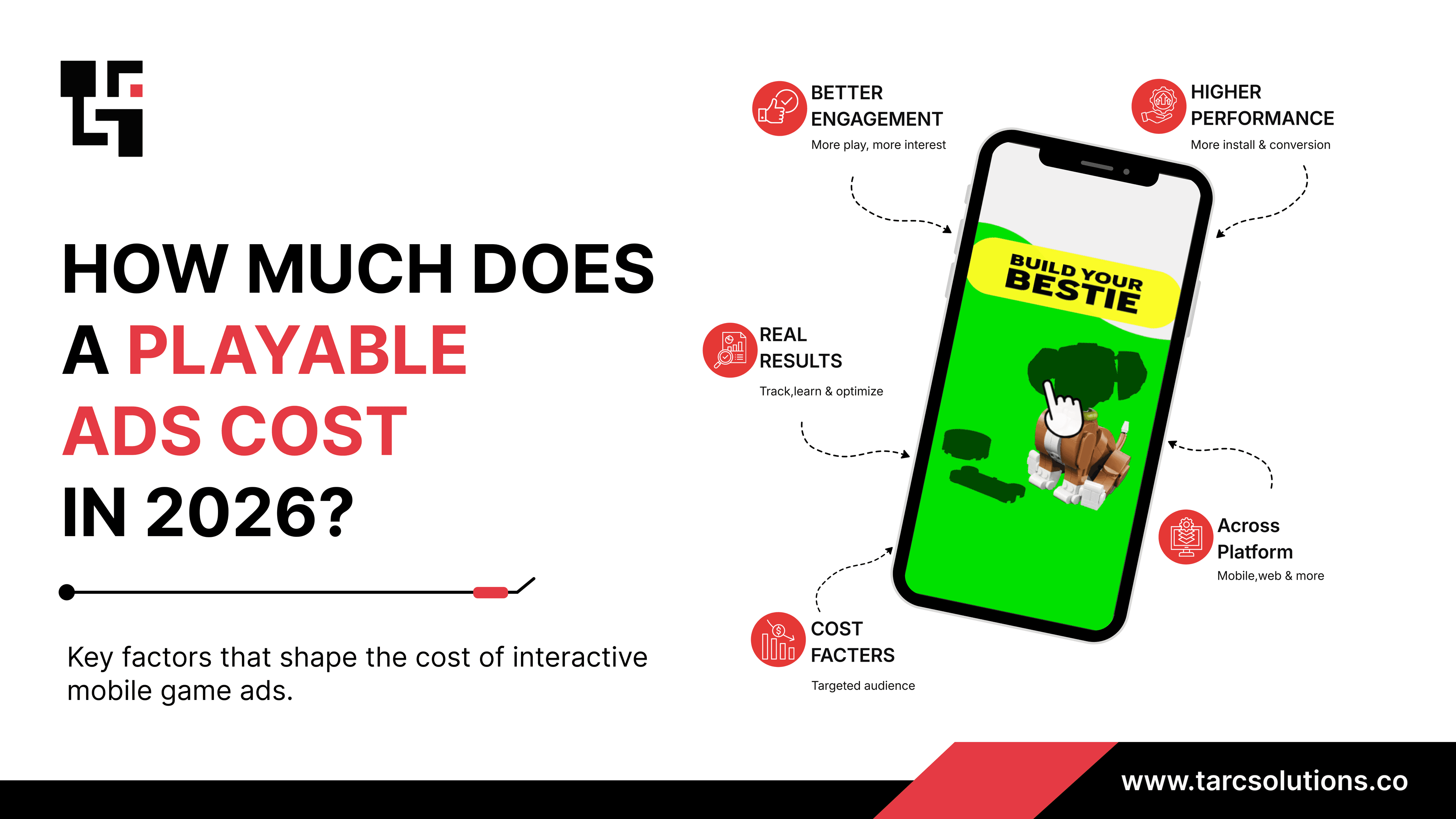
- See live examples: Build Your Bestie playable series and the case study
- Scope, process and FAQs: Playable ad development
- Get a quote: send a short brief with your game, target networks and deadline
FAQ
How much does a simple playable ad cost?
A single-mechanic HTML5 playable typically costs a few hundred to a few thousand dollars. Freelance marketplace builds run about $200 to $3,000; TARC's start at $300.
Why do some studios charge $20,000 or more?
Those quotes usually cover concept work, custom art, several scenes and builds for many networks. If you already have art and a clear mechanic, you rarely need that scope.
Can one playable run on every ad network?
Not as one file. Each network uses a different install call and packaging. A well-structured playable shares one game build and swaps a small wrapper per network.
What file size should a playable be?
Aim for under 2 MB. That fits Meta's single-file limit and clears the 5 MB cap on AppLovin, Google, Unity and TikTok.
Is ironSource still an option for playable ads?
No. Unity stopped serving ironSource Ads direct demand campaigns on 30 April 2026. Unity Ads is the replacement.
How long does a playable ad take to build?
One to two weeks for a single-mechanic playable, three to five weeks for a custom multi-scene build, plus network review time.